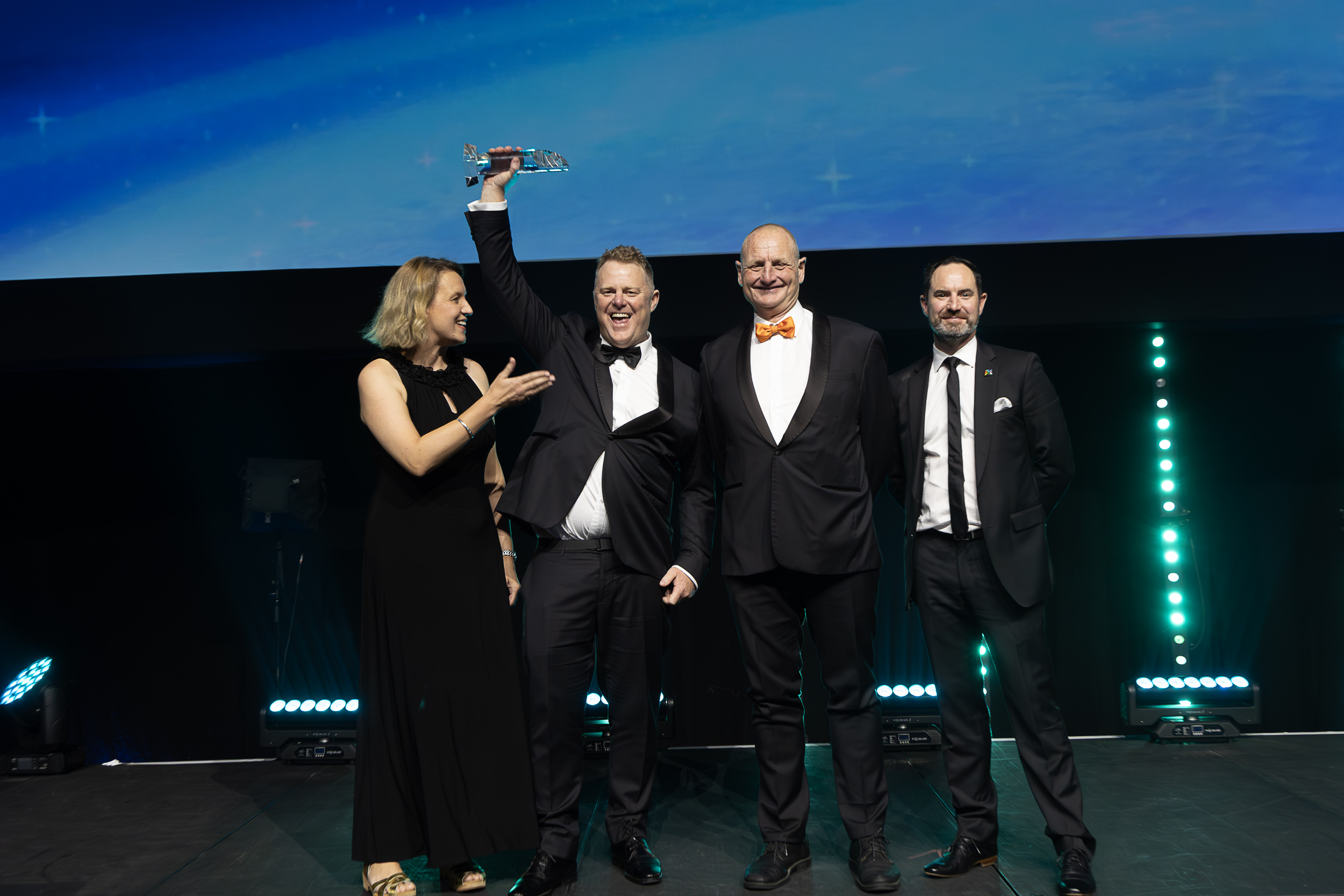
The 2026 NZ Hi-Tech Awards received more than 300 entries across 14 categories, the highest in the awards’ history. That number alone tells a story worth paying attention to.
Four companies from across our Punakaiki Fund and Climate Venture Capital Fund portfolios were named finalists this year: Hectre in three categories, Astute Access and Cleanery in Manufacturing, and Sea-Flux in Startup Company of the Year. We’re proud of all of them. But what I find most interesting about the Hi-Tech Awards isn’t any single year’s finalists, it’s what happens to them afterwards.
The trajectory of past finalists
Look at the companies that have stood on the Hi-Tech Awards stage over the past decade and trace where they ended up.
Rocket Lab won Company of the Year in 2024. Peter Beck’s space technology company is now US-listed and valued in the billions, one of the most valuable companies ever built in New Zealand. But Beck was showing up at the Hi-Tech Awards long before Rocket Lab was a household name.
Vend won two awards in 2012 and 2013 as a Wellington point-of-sale startup. It grew into a global retail platform used by thousands of retailers worldwide, and was ultimately acquired by Canadian company Lightspeed Commerce. A genuine NZ technology success story though one where the long-term value creation ultimately left the country.
Halter was a finalist in 2023. Three years later, it’s a finalist for Company of the Year, the top category alongside Aroa Biosurgery, Auror, Dawn Aerospace, Gallagher Group, and Tait Communications. That progression from finalist to contender mirrors Halter’s own growth from a dairy-tech startup into one of New Zealand’s most significant private technology companies as shown by its recent $377 million raise at $3.3 billion valuation.
Tracksuit won Emerging Company of the Year in 2024 and has continued to scale rapidly into global markets. Moxion won both the Creative Technology and Startup awards in 2021, a Punakaiki Fund portfolio company that went on to be acquired by Autodesk, proving that Hollywood-grade production technology could be built from New Zealand. Timely, another former PFL company, built a global salon and spa management platform before being acquired by EverCommerce.
And NovoLabs a Climate Venture Capital Fund portfolio company, won three awards in 2024 for its breakthrough water treatment technology developed at Massey University. Three wins in a single year, across Hardware, Sustainable Future, and Deep Tech.
What the pattern suggests
Not every finalist goes on to build a globally significant company. That’s venture capital, not every bet pays off. But the correlation between Hi-Tech Awards recognition and subsequent scale is striking. The awards function as a credible signal of innovation quality, and the companies that show up here are disproportionately the ones that go on to matter.
This year’s finalists from our portfolio
Hectre is the standout. Being named a finalist in three categories: Emerging Company, Agritech, and Māori Company of the Year, reflects the breadth of what founder Matty Blomfield and his team are building. Hectre’s fruit scanning tech and orchard management software now serves customers in 22 countries. They’ve scanned over 3.8 billion pieces of fruit (and counting) with revenue growing at around 100% annually. Our Punakaiki Fund recently led their oversubscribed $12 million Series A which is helping them to scale faster as well as embark on building a world-first hyperspectral camera that will rapidly size and grade fruit. Come on now!
Astute Access is pioneering enterprise smart lock solutions for utilities and critical infrastructure, replacing physical keys with mobile-based access control. Their technology is already deployed with water utilities, councils, and telecommunications infrastructure across New Zealand and Australia. Being a Manufacturing finalist alongside companies like Fisher & Paykel Technologies and Aroa Biosurgery puts them in serious company.
They also have stiff competition in Cleanery who are looking to back up their 2025 win for Most Innovative Hi-Tech Solution for a More Sustainable Future in the Manufacturing category. Cleanery’s patented sachet-based cleaning products reduce plastic packaging by 99% and are now on-shelf in major supermarket chains across New Zealand, Australia and the United States. We recently hosted some of our community at their factory in Avondale and it is remarkable to see the scale of sustainable products the team can manufacture and ship from a small but deeply technical and efficient factory footprint in west Auckland.
Finally, Sea-Flux, founded by former superyacht skipper Tai Ellis, has built cloud-based vessel management software now used on over 1,300 vessels worldwide. The company won the Innovation Award at the European Commercial Marine Awards in 2024, and being a Startup finalist here confirms what the international maritime industry is already recognising.
What 300+ entries tells us
The record entry count matters. It suggests the NZ tech ecosystem is producing more companies of genuine quality than at any point in its history. More founders building real products. More categories to recognise them in. More depth.
If the Hi-Tech Awards are a barometer of ecosystem health, the reading right now is very strong. And if history is any guide, several of the class of 2026 will go on to build businesses that matter well beyond New Zealand.
We’ll be at the Gala on 22 May cheering them all on, as a sponsor, as investors in four of them, and as believers in what this ecosystem is capable of producing.